Thursday, November 3, 2011

An Autumnal Chawan

It's early November, the leaves have turned to amazing tints and shades of red, yellow, orange and gold and the winds of autumn are beginning to chill the air.   I’ve been thinking about how this time of year seems to compel us to merge hot tea with bowl and about the fire and energy that creates that merging moment.  Every time of year is the perfect time for tea but the cool breezes, colors and haze of autumn, in my part of the world, seem to make the merging of tea and teabowl even more necessary. 
To illustrate this, I’m turning once again to a bowl by the renowned teabowl artist Min Young Ki.  He created a magnificent bowl that warms me just thinking about it. 


This bowl was born of fire and seems to keep the warmth of that flame within its soul.


The kiln that produced it seems almost haphazard.  Made of stone, clay and brick, the dome is cracked, yet there is nothing haphazard about the work that emerges.   Still, like most Korean teabowl artists, thousands are made, few chosen for the honor of serving tea.


Among all the teabowls that were selected, this teabowl is the epitome of autumn.  Let’s look at it again.


The bowl exudes warmth, not scorching HEAT, “warmth” with all the ramifications of that word.  You can almost feel how this bowl fits your hands and radiates that warmth into your bones. 


The natural feldspathic glaze creates a haze across the bowl.  We can almost see leaves drifting in the distance. 

   
Like autumn the weather changes.  Some days are warmer than others. . .


. . . and slowly the cool breezes of winter begin to appear. 


Like earth the foot is dark and strong holding above it all of autumn in a magnificent bowl.  
Click here to go to the next post.


Saturday, March 26, 2011

Tranquility: Another Taste

Please Read Previous Post First


Min Young Ki

“I don’t get it.  This is just a common bowl.  I can find lots of bowls like this on my college student’s shelves and I have them throw most of them out.”  A well-known American potter said this to me while showing me a photo of a nice Korean tea bowl.  That bowl was similar in color and form to this bowl but; to be fair, it was not this bowl he was referring to.  Never the less, bowls like this may not be for everyone.  This bowl is so “simple” so “plain”, un-agitated, innocent, natural and “ordinary”.
Before I began this post I had a very brief moment when I thought I might attempt to “enlighten” that potter and others to the beauty of this bowl by discussing the things about it that make it truly a very special tea bowl.  What a pompous, naïve thought that was!  Unless there is personal insight nothing more can be said or seen. 
In addition, I’m certain that I don’t always “get it”.  If I understood or felt a tiny fraction of what can or should be understood or felt about chawan it might give me a little peace in this search.  I am sure that there are many really good chawan that I don’t yet “see” or “feel”.  So who am I to judge others?
This particular Min bowl is probably easier to “feel” but may be more difficult to “see”. 
When tasting various teas for the first time it often takes me more than one sitting to fully appreciate the various nuances that tea can provide.  It seems to be the same with chawan.  This post is here simply to give you another taste.

Click on images once or twice to enlarge


Soetsu Yanagi wrote of the Kizaemon Ido Teabowl:
Why should beauty emerge from the world of the ordinary? The answer is because that world is natural. In Zen there is a saying that at the far end of the road lies effortless peace. What more can be desired?  So, too, peaceful beauty. The beauty of the Kizaemon Ido bowl is that of strifeless peace . . . . .
and this chawan?
  Peace
Click here to go to the next post. 

Wednesday, March 23, 2011

Tranquility


Min Young Ki

Sometimes it is the simplest things that make the most lasting impressions.  Grace does not go unnoticed, a gentle breeze is more appreciated than a gale and calm doesn’t have to be followed by a storm.  Such it is with this particular chawan by Min Young Ki.  How can hard fired clay emerging from earth and fire seem like gossamer?  How can hard fired clay seem so delicate?  Not “fragile” but “delicate”.  This tea bowl is the epitome of “peace” and that is why I am presenting it to you just after the devastating events in Japan.  We need a little “peace’.  We need a quiet moment when we can simply sit, perhaps with warm green tea in a favorite ch’at-chan or be with our favorite chawan and some Japanese matcha to contemplate the moment while clearing our minds of all else.  It is moments like this that tea and bowl or cup become one.  It is for moments like this that Tea, bowl and cup are made.  This chawan is the epitome of tranquility.  Subtle in color and form this bowl’s presence is “felt” before “seen”.  Such serene and tranquil moments come too seldom.
Peace.

Chick on images once to enlarge twice to zoom in

Please go to Next Post Tranquility: Another Taste

Saturday, March 12, 2011

The Effect of the Sendai Earthquake and Tsunami on Ceramics in Japan


This post is dedicated to the victims of the Sendai earthquake and Tsunami.  It is without images but does contain links to many images and other web related sites.

My family is keenly aware of earthquakes.  As a young child my father survived the San Francisco Earthquake of 1906 (7.9-8.25).  More than 3000 people were lost.  Dad remembers running out of his home then turning around and watching his home collapse.  When he spoke of this on a recording I made of him while he was in his 70’s he reached down to rub his leg and said, ”I can still feel that shaking in my legs.”  My brother, who was a professor working near Kobe, Japan survived the Great Hanshin earthquake or Kobe earthquake in 1995 (7.3).  6433 people lost their lives and it lasted for 20 seconds.  An armoire fell and hit my brother on his head while he slept.  He survived but still suffers from the incident.  I fortunately have never experienced an earthquake or at least one I felt. 
This is a devastating time in Japan’s history.  Everyone can feel greatly saddened at Japan’s loss in lives and property.  Can you imagine an 8.9 earthquake that lasted for two minutes and created a tsunami that caused 7 ft waves along the western coast of the United States and down the coast of South America?  There have been ‘aftershocks’ from this earthquake nearly the size of the Kobe earthquake of 1995.  The power of this earthquake and tsunami is beyond measure or full comprehension.  We have no idea of the death toll from the Sendai earthquake and tsunami.  We do know that Sendai is a city of about 1 million people and it was greatly damaged.  We also know that about 10,000 people are reportedly unaccounted for in the Japanese port town of Minamisanriku in quake-hit Miyagi prefecture.   In addition, two high-speed bullet trains were missing alongside a cruise ship carrying 100 passengers that was swept away when the wave hit. One of the trains was reported to be carrying 400 passengers.  Sadly the number of lost lives will be enormous.
The people of Japan will feel the effect of this earthquake and the tsunami beyond the life expectancy of anyone who actually experienced it.
The loss of property is unimportant.  A single life cannot be measured against any amount of ‘property’.  But for those of us in ceramics, the effect these events have had or will have on ceramics in Japan may still be of interest, even if it is merely a diversion from the great sadness we feel from the loss of lives. 
Miyagi prefecture where the city of Sendai is located is not known for their chawan but is well known for folk pottery.  Kirikomi-yaki and Tsutsumi-yaki are from the Miyagi prefecture.  The Miyagi prefecture has several ceramic related museums.  They include:

MUSEUM OF JOMON ART
A two hundred piece collection of Jomon earthenware forms the core of this museum. Amassed by poet Sakon Sou, the museum is housed in a specially renovated 'kura' or an old Japanese warehouse.

TOHOKU Modern Pottery and Porcelain Museum
Tohoku Modern Pottery and Porcelain Museum was established in 1987 in order to preserve the folk ceramic culture in the region. The collection includes folk pottery and porcelain of Tohoku region made during Edo, Meiji and Taisho period are mainly shown. Kirikomi-yaki and Tsutsumi-yaki of Miyagi prefecture, Aizu-Hongo-yaki, Obori-Soma-yaki, Soma-Koma-yaki of Fukushima prefecture, Hirashimizu-yaki of Yamagata prefecture and Shiroiwa-yaki of Akita prefecture are on display.  A true folk art museum
(Examples of this work are difficult to find on the the English web, If you have links to these on Japanese web sites, I would appreciate that information )

The Marusu Museum
The Marusu Museum was established in 1950 to house the collection of Suda family in the region. The collection includes earthenware, Sue-style wareT'ang three-colored potteryKyo-yakiImari-yakiKutani-yakiSeto-yakiMino-yaki, Shigaraki-yakiIga-yakiBanko-yaki,  Aizu-yaki and other ceramic ware are on display.
(This is the museum for tea ware including many chawan.)

The Akamon Museum located in Sendai
The Akamon Museum was established in 1982. The collection includes brush paintings, western paintings pottery and porcelain, swords, armors, helmets of samurai, sculptures as well as literature related to the local clan family in the region are mainly on display.

Thank you e-yakimono.net for some of this information

The earthquake affected many ceramic artists and art groups.  We have no idea how many.  However at last report Kelly Cox, an American ceramic artist traveling in Japan, is still missing.  Her wedding is planned for April.  I hope that she will post a comment on this site saying that she is well.  If you know Kelly and she is well, please have her post a comment on this blog.  I have great hope for Kelly’s survival since NewsCore recently posted the following statement. “The US has accounted for ‘most all’ of Americans known to be in Japan after the country was hit by a massive earthquake and tsunami Friday”. ( Since this post I heard third-hand that Kelly survived and had her wedding! Congratulations!)
The Walker Art Center in Minneapolis, Minnesota was conducting a tour to Japan for their members and staff.  All are safe.
Columbus State University in Georgia had a small group of ceramic students studying ceramics in Japan.  All are safe.  
Ian MacDougall a Canadian living in Japan since 1984 commented, “The earthquake smashed one of my wife’s nicest pieces of pottery, but that’s the worst it did to us.”CBC.  Multiply that comment by the thousands of others that also lost their “nicest pieces of pottery”.
Euan Craig, an Australian potter living and working in Mashiko, Japan, felt the effects of this quake and wrote about it in his blog.  They are safe but the kiln is damaged and they have no insurance because it was leased to someone without insurance.  I'm sure they could use some help.
We now know that Mashiko, Japan was greatly damages,  It has been reported that nearly all kilns in Mashiko suffered some damage and many pots were broken.   Koichiro Isaka has posted damage to Hamada's kilns on his Facebook page.  Look on his "wall".  There was considerable damage to Hamada's Reference Museum containing some of his best work.  Many pieces were lost.  I worked with Hamada Shoji in 1963 so I feel that loss very deeply. 
Ken Matsuzaki has established a relief fund for the Mashiko Potter Foundation.  Currently that fund only receives money by bank transfer which costs $45 USD to the bank if transferred internationally from the United States.  I'll contact Ken to see if there is another way to contribute and post that here if he answers.  In the meantime if you don't mind the bank getting that much, contact me, prove you are a ceramic artist and I'll send you that bank swift code etc.  I am sure you can find it other places.  As you probably already know, when you have that type of bank information, someone can take out as easily as put in.  I have suggested to Ken that he use PayPal or a credit card system.  
Jan at Jane Street Clayworks has an interesting post on the disaster with several quotes and their links related to ceramics.
I can’t get my head around a post on tea bowls right now but think we all could make a small difference in the situation in Japan if we each donated the profit from just one ceramic item.  How about the profit from a day's work?
I’m sure you have your favorite places to make donations to relief efforts like this.  My favorite places to donate are:
Those funds won't help the potters but there is great need and each of these organizations does great work in areas that need disaster relief.  Japan has given the ceramic world so much.  Perhaps it is time we give a little back.
The Leach Pottery in St Ives England has established a relief fund for the potters in Mashiko, Japan.  Contact Julia if you would like to make a special donation there.   
Be sure to avoid unknown or little known relief agencies and private individuals no matter who they say they are.  I'm sure the St. Ives pottery  and Ken Matsuzaki are fine.  
Also avoid those who say they are posting images from the disaster and ask you to log on.  There may be unwanted cookies attached.
Now we can only pray for the victims of this disaster and for all of Japan.
Peace.
Click here to go to the next post.

Sunday, November 21, 2010

The "Powdery Matsudaira" Revisited

(Click on Images to enlarge.  Use back arrow to return to post.)
I am sure that you are wondering why I would 'revisit' a chawan like the "Powdery Matsudaira".  As my subtitle, "An Adventure Toward Insight and Clarity", suggests; this blog is an adventure.  In addition, my first sentence on my introduction to this blog is, "I begin this blog knowing I have a profound lack of understanding and knowledge on the subject of Tea bowls."
In my earlier post on "Powdery Matsudaira" I wrote:
To many Tea ware artist and connoisseurs, the “Powdery” Matsudaira, like the Kizaemon, embodies the ‘essence of tea’.  From the moment it was formed on a humble wheel, to the quick dipping into slip ‘tum bung’ that left an accidental bare mark revealing the clay body - in a “tealeaf-like” pattern, to the accidental drip across that mark made when the potter lifted the bowl to keep the excess slip on the bowl, this was destined to be a great bowl.  Tiny specks of natural stone peeked through the slip at the peak of the firing.  This slip, like that on many old tum bung buncheong pieces, was more than strictly a “slip”.  It was a slip glaze fusing slightly and sealing the body.  More than likely it was also ‘single fired’, without the benefit of bisque firing.  This chawan is beautiful, capturing many moments of the forming, ‘glazing’ and firing process.  The inner and outer powers have become one in this amazing chawan.
I have been thinking about this bowl lately because I have been doing some dipped slip buncheong tea cups and tea bowls for my own work.  This is not something new for me but rather something I return to from time to time just to mix things up a little and try to keep myself fresh.
One of the things that has always bothered me about the "Powdery Matsudaira" is it has never really had the nuance characteristics of a slip.  That is why in my original post I said it was a "slip glaze".  The title of the piece uses the word "powdery" suggesting a slip was used.  The word 'bun' in 'buncheong' essentually means 'powder'.  But in creating buncheong slip ware, usually a clear glaze is placed over the slip causing the dark exposed clay to have a shine.   In nearly every book or writing on the "Powdery Matsudaira", it is categorized as a slip glazed or buncheong bowl.  Every Korean tea bowl artist who copies it uses slip with a clear glaze over it.  I wrote that it was a "slip glaze" because it didn't have the same 'feel' as other buncheong pieces that have clear glazes over them.
Recently, I was staying with our friend, the potter Park Jong Il, and his family in the mountains outside of Gyeongju, Korea.  One evening, we were just talking about pottery when I asked him if he thought the "Powdery Matsudaira" used a slip glaze?  It is a question that has bothered me for sometime.  His immediate reply was, "No, just a slip".  I responded,  "If it was just a slip why is there no shine on the dark portion of the bowl and why does it look more like a glaze?"  "Let's see."  Jong Il said.  With that statement he went to his books and pulled out a very large book in Japanese on tea bowls.  It was a remarkable book filled with amazing work and I hope to someday obtain a copy.  After searching for a few moments he exclaimed, "You're right!  It is a glaze."  Now I was at his side looking at a grouping of very large photos of the "Powdery Matsudaira" showing this bowl in clear detail like I had never seen it before.  It showed the bowl in many positions, foot, lip the bare pattern, everything.  But I was wrong, it was not a "slip glaze" it was glazed with a white porcelain glaze "paekcha" that was used like one would apply a slip!  Amazing!
What we read, clearly effects what we see.  What we think we know, based on years of experience and reading, can still perpetuate misinformation as readily as it can provide the truth.
I apologize for my earlier post on the "Powdery Matsudaira" suggesting that a 'slip glaze' was used.  But I am happy to provide this clarification as we move toward even more insight and clarity.
PS: I'm sorry I do not have an image of the "Powdery Matsudaira" from that large Japanese book nor would I have permission to post it if I did.  I do have permission to post the above photo and have inserted it twice as large as before.  Click on it to see the enlarged view and use the 'back' arrow to return to this blog.  Thanks for following us.

Added to the post:  12/5/2011
Because of the questions about this bowl, I decided to use Photoshop in an attempt to get a little closer to the images I saw in the Japanese book.  The first image is the traditional image found in many publications.  It appears 'yellowed' by age.  The second image, altered by photoshop by removing some of the 'yellow', is much closer to the images I saw in the book mentioned above.  One may argue that the 'original' image should not be altered.  From seeing the new book, that 'original' image doesn't reflect the true nature of this piece.  In any case this is just a blog, not my doctorial dissertation on this bowl.  I'm simply attempting to present a clear and honest portrayal of the bowl as I now know it. 

      The original commonly used photo of The "Powdery Matsudaira".  

Compare the above photo to the next photo.

 The whiter image of the "Powdery Matsudaira" 

The above image is much closer to the images I saw in the teabowl book.

 
Comparing the color change I made

My apologies if this attempt at clarification is beginning to add confusion.
Click here to go to the next post.

Because I had a computer glitz, the following was added 11/24/2011
I am perplexed.  I have received a couple of comments and can't return a comment myself.  For some reason neither of my computers will allow me to comment on my own blogs.  So, I'll post a comment here until that can be corrected.  
Thanks for your comments.
It was impossible to mistake either the photos or the text found in this Japanese chawan book.  I had never before seen photos of the "Powdery Matsudaira" or any of the other tea bowls like the ones in this book.  Each photo was up close and included several photos of every chawan taken in good light with great detail.  In addition the text clearly states, in Japanese translated by Jong Il, that this bowl we know as the  "Powdery Matsudaira" was glazed with a Korean porcelain glaze.  It was neither a slip glaze, as I wrote originally, nor was it covered with a slip in any way.  It was simply glazed with a porcelain glaze.  This is particularly interesting to me because this bowl has been one of the standards for the buncheong process of dipping one's bowl in slip.  We had assumed that slip was used.  Books, articles and blog posts like my earlier one perpetuate that myth.  For my part, I'm sorry.  It didn't look right from the one photo I had.  As much as I want that bowl to be dipped into slip, as much as nearly everyone thought it had been dipped into slip, as much as it looks like old slip with the chipping on the lip and foot in the above photo, it is not slip.  If I'm able to obtain my own copy of that book I'll ask for permission to post some of the better photos here.  In the meantime, the additional highly detailed photos that I saw and text in that book answered my questions.  I hope I have answered yours.         


Friday, May 28, 2010

Han Dynasty Tea Bowl

May 16th was the night of the Lotus Lantern Festival in Seoul so we planned our stay so that we would be in Seoul that night to enjoy it.  For sheer pageantry the events surrounding the Lotus Lantern Festival are probably unsurpassed in Korea.   A hundred thousand or more Buddhists from many countries come together to celebrate the coming of Buddha’s birthday by parading magnificent lanterns through the streets of Seoul.  (click images to enlarge)


But we would not witness the 2010 Lotus Lantern Festival.  We were otherwise engaged in a more exciting experience.

On our recent trip to Korea, to participate in the Mungyeong Chassabal Festival we stayed a little longer to tour Gangjin, Jirisan, Gyeongju and Seoul.  Gangjin and Jirisan are rich in their tea and tea histories and I’ll eventually be posting some of what we found about tea and tea history on my Morning Crane Tea blog.  Instead, for my first post since returning home, I think I should begin with something very early.  
It was in Jirisan that my friend Park Jong-Il introduced us to his tea teacher Kim Sung Tae.  Master Kim Sung Tae was leading a group of tea masters, potters and simply interested followers on an excursion that included making green and ddokcha teas the Chinese way.  Some of that experience will also eventually be found on my tea blog.  But more important, for this blog, Kim Sung Tae, is also a connoisseur of tea ware.  During his more than 300 visits to China in the last ten years he studied many of the ancient ways of making and preparing tea, and collected both Chinese tea and Chinese tea ware. In fact his knowledge and understanding of Chinese tea and Chinese tea ware is probably unsurpassed in Korea.  With more than 20,000 tea ware pieces, I can’t imagine any other collector (including major museums in Korea) that would have in their collection more (or a greater variety of) Chinese tea ware than Master Kim Sung Tae.  Who would have thought that we would find so much about Chinese tea in Korea?
For most of us in the Western world, when we think of teabowls, our minds think of Japan.  There are international exhibits where Western ceramic artists try to show how close they have come to expressing the qualities found in Japanese tea bowls.  In the process little thought is given to either China or Korea.  In reality, compared to China and Korea, Japan is a latecomer to tea and tea bowls.  Both China and Korea had teabowls, dawan or chawan hundreds of years before Japan and Japan owes much gratitude to both countries.  As I said in another post, one scholar said that removing Korea’s influence alone from Japan’s ceramics would be like removing all African Americans from the Jazz Hall of Fame.  If you also then removed China’s influence from Japan’s ceramics, very little if anything would be left.
There is an old saying, “Begin at the beginning.”  But who can really say what bowl the Chinese Emperor Shennong drank from in 2737 BCE when an errant tealeaf fell into his cup of hot water (or do you prefer another story of the beginning of tea). 


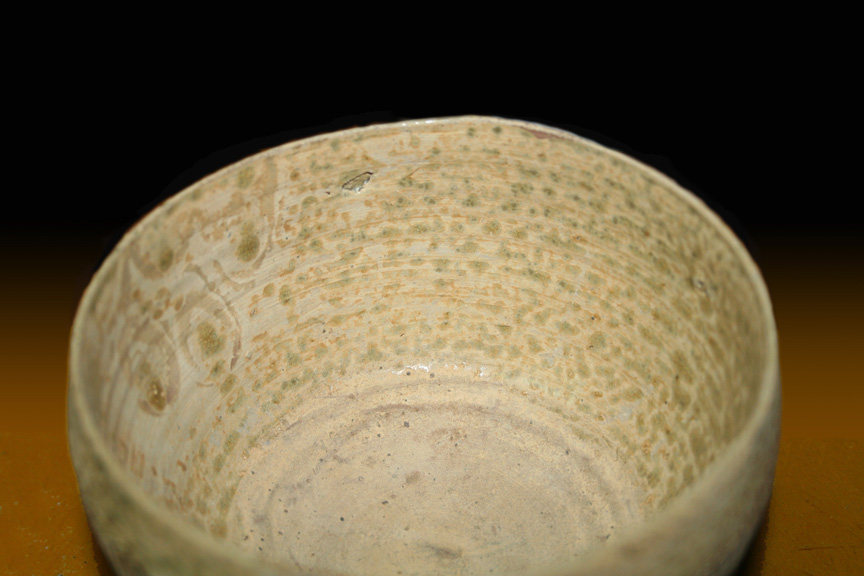
There was nothing errant about the glazing, decorating and firing of this Chinese tea bowl that reportedly dates as early as 150 BCE.  That puts this glazed bowl back to the early Western Han period (206 BCE-9 CE).  
I knew that an applied ash glaze was used in China quite early but seeing this ash glazed bowl in person was a shock.  Frankly I have not studied Chinese tea ware much - as most of my efforts have been focused on Korea and Japan.  I knew that Korea’s Three  Kingdom Period (57 BCE – 618 CE) had kilns that would reach the melting temperature of ash but seeing this simple Chinese ash glazed bowl - that Master Kim Sung Tae swears was most likely made for tea - still alive - blows my mind. 
By ‘alive’ I mean you can still feel the power of the potter in this piece.  The bowl is approximately 12 cm wide and 6 cm high; a perfect size for tea even today.  It fits the hand beautifully.  Obviously it was thrown on the wheel then decorated with a simple probably wooden rolling stamp that the potter in his haste inadvertently also touched to the rim of the bowl.  The clay for this bowl was not fully prepared.  A broken air pocket can be easily seen.  The ash glaze, most likely simply composed of ashes, was thinned with water then the bowl simply held and quickly dipped into the glaze.  The fingers, inside the bowl, left their mark forever.


In my mind I sat with this potter watching as he turned the heavy wheel, pulling it toward him with his right hand so that the wheel turned clockwise.*(see below)
This bowl was one of many that day, each formed alone from individual pieces of clay.  (It would probably be years later when many similar bowls would be formed from a single mound of clay.)  The rolled decoration was applied immediately, probably with a wooden wheel stamp that was held loosely attached to the end of a stick in one of several ways and rolled around the bowl before it was trimmed and then lifted from the wheel.**  But on this day there were many bowls formed then set aside to stiffen (not dry) and glazed. 
Grasped with two fingers on the inside, the bowl was quickly dipped in a simple thin glaze composed of ash and water.  As the freshly glazed bowl sat drying, at one point the potter picked the still wet bowl up again, moving it to make room for another bowl.  Thus four fingerprints are seen inside the bowl. 
The practice of glazing stiff but not fully dry ware continues for common utilitarian ware in Asia today.  Bisque firing before glazing came much later when glazing practices became more sophisticated. 
After sitting a few days to dry, the bowl was placed with many other items into a long slopping kiln and was fired with wood in a mostly oxidizing flame.  The slope helped the kiln to be very efficient as it reached nearly white heat – hot enough to melt the ash glaze. 
More than 2000 years later this simple tea bowl is still 'alive' and possesses many of the natural “touched by the potter” characteristics greatly desired by chawan connoisseurs today.  But this tea bowl was not used for a “tea ceremony”.  It was used to drink tea as a medicine – and most likely not a medicine to cure illness but to prevent illnesses from occurring.  Tea was then, and is today, perfect for Chinese medicine that focuses on the prevention of health problems, as much as rehabilitation, and turns to tea and other herbs for this purpose.

*Koreans and Europeans would add a flywheel to their potter’s wheel that allowed them to be kicked with the right foot away from the potter or ‘counterclockwise’.  Both directions are ‘right handed’, actually one is right handed the other right footed but in any case we should not refer to either direction as ‘left handed’.  They are simply directions for working with the wheel spinning in the direction most often used in ones country.  In the case of Korea the direction changes often, sometimes even with the same potter, depending on the wheel and whether or not they want their strongest hand inside or outside the vessel.  In Korean onggi the wheel is pulled with the left foot in a counter clockwise direction.  This is an adaptation developed from an ancient hand building method.
**There are a couple of ways the wooden rolling stamp may have been applied while the pot was still on the wheel.  Both ways involve a wheel shaped wooden stamp with the decoration carved in (similar to treads on a tire).  The center of the wheel has a hole.  There are two methods, that I have seen used in Asia, used to hold the wheel.  The first is a simple stick with a nail on its end.  The wheel sits on the nail.  The second involves a "Y" shaped stick similar to a slingshot.   The rolling stamp is placed between the two prongs of the "Y" also held by a nail or wooden dowel.  
Ask about our Korean ceramic workshops.
Click here to go to the next post.

Friday, April 16, 2010

Red Shino Chawan T 575

Red Shino T 575 
5.25” x 2.5”   13.3 cm x 6.4 cm

When I created this blog, my intent was to look at chawan by other artists but for some reason one of my chawan keeps popping up.  First it was a photo I found while cleaning, then it popped up on my computer seemingly out of nowhere.  I guess it is trying to get noticed.   You may or may not like it.  It really doesn’t fall into the wabi category.  In some ways it is too pretty – like a woman with a little too much makeup.  But never the less I’m attracted to it.  Also don’t get too excited if you do like it.  It sold about 5-6 years ago and I haven’t been able to get this effect again.  My clay body ingredients have changed and some of the glaze ingredients are also mined a little deeper in the mine.  That or something else is keeping me from repeating this glaze effect – so in keeping with my philosophy, I moved on, accepting the “the way of Tariki” or ‘outer forces’ (in Japanese).  I wish I knew the equivalent of that term in Korean.  There are other Korean philosophical positions that we’ll discuss some other time.
At one time I was able to get this effect on a lot of tea bowls.  This one in white is now in an important collection.


I also used it on vases . . .


and on other forms in red.


You might actually like the above examples better than the teabowl that has been haunting me. 


But this bowl in spite of its pretty look has a more Korean form and feel.


When one makes a lot of tea bowls many of them just seem to pass one like waves in the night.  I can recognize them as mine if I see them again but can’t remember them specifically or as being special.  Over the years there are a few that somehow stand out as being memorable.  


Memorable doesn’t necessarily mean they are really good but simply that for some reason they stick in my mind.  Such is the case with Red Shino T575. 
There are many different kinds of shino colors - red, white, gray, black, rat etc.  There are also many shino glaze formulas, possibly hundreds or even thousands, slightly altered with more or less the same ingredients in varying amounts.  The feldspars change, the percentage of soda ash varies from a little to a lot, or a little red art clay or even tin is added.  Under various circumstances the results of the same glaze fired in the same way in the same kiln can give a variety of results.  With different clay bodies the variety is increased.  One might be firing wood or gas or possibly even electric (although I never personally fired shino in an electric kiln).  The heat source adds other dimensions.  The maturing temperature might be from cone 7 to 15.  Somewhere in there you should find a glaze result that you want to think about a little more.  As I said, for me one of those chawan is Red Shino T575.


In addition to the obvious glaze effect, this bowl just seems to feel right in the hand.  It is relaxed and natural in form.  I think I have been looking at too many bowls by other potters that are a little tighter than mine.


In recent years I have been going to Korea often and have been studying tea bowls by ‘the masters’.  Some of them throw with a little more precision than me.  I find myself getting a little tighter attempting to get some ‘classic’ results but in the process. I’m getting further and further away from me
I just unloaded a kiln and threw away something like 30 of 40 bowls and I wasn’t excited about the remaining ten.  So I guess I’m saying to myself that after 50+ years of this I should get back to me and stop trying to please someone else’s chawan spirits.  Mine get a little angry or jealous when I do that and let’s me know it pretty quickly. 
I still have a hard time making really predictable work using tried and true glazes that always come out the same.  I did that for a while when I worked in porcelain, but I like the mystery of ‘the Tariki’ and am most excited and pleased when my chawan spirits smile on me.  
Of course this is no way to make a good living.  Many customers like predictability so that if they break one of your chawan they can come back and buy another one just like it.  But, for me, that is not a chawan.  It might be a bowl but it is not a chawan.  A chawan must have within it something stirring and a life that is a little different than others even its twin if one exists. 
Have you noticed?  I’m having difficult time writing about or analyzing my own work – even when I share the work with ‘the Teriki’.
So this lopsided, loosely thrown ‘red’ will just have to wait until someone else takes an analytical crack at it.  It has done its job of getting me back to me.
Influence yourself.
Click here to go to the next post.
 

PS: This bowl was purchased by a major collection in Korea. So it has a good home.