Friday, March 19, 2010

Celadon Tea Bowls: A Simple Bowl


It is one of history’s incongruities that what have become the greatest teabowls in history, like the Kizaemon Ido and the “Powdery” Matsudaira, were created during Korea’s Joseon (or Choson) Dynasty (1392-1910) when the use of tea was in decline in Korea.
The greatest use of tea in Korea took place earlier during the Goryeo (or Koryo) Dynasty (918-1392) when the royal court, aristocracy, Buddhist monks and commoners all celebrated tea for common drink and ritual.
It was during the Goryeo that the Buddhist Way of Tea was more fully developed and practiced.  The Way involved a tea bowl not a tea cup and powdered tea.  The powdered tea of Goryeo did not come in a can pre-ground into fine powder like the maccha or matcha we enjoy today.  Rather, after the tea was pressed into a block it was aged several months before drinking. 
Each detail from the preparation of the fire and boiling of water to the careful grinding of the tea into a powder, in the presence of the recipient(s), then the preparation and serving of the tea were all part of the Buddhist Way of tea during the Goryeo Dynasty. 
Of course Goryeo tea bowls were used.  Many were glazed with a celadon glaze.
Some years ago I found such a celadon tea bowl in an antique shop in the USA.  It was cracked and chipped but still authentic Goryeo.  What a find!  Not for its monetary value (which in spite of its age is slight) or its continuing function, but for its grace and color.  It is a simple bowl with no carving or inlay, which - if not cracked and chipped - would dramatically raise its monetary value.  Our bowl is one of thousands of similar bowls probably made for the common market at the time.  But the grace of its curve and the way it fits my hands is unparalleled. 
Each time I hold this bowl I am drawn back in time and sit with a monk serving tea in the Goryeo Buddhist Way of Tea.  Tea grew wild behind the temple perhaps in a grove of bamboo.  There only the fresh new leaves were picked for tea.  Then, it was processed by roasting on a hot metal plate.  The leaves were pressed into a block and aged until this moment when the monk silently breaks the block of tea and with a special spoon grinds the tea into powder and prepares it.  Pure mountain water has been drawn from the temple spring for this moment.   The taste is subtle, not strong with a very light slightly burnt flavor – delicious.  We sit peacefully and respectfully in meditative silence enjoying the tea, enjoying the bowl, contemplating the moment.  Not a word is spoken.


This ancient bowl swells up from a narrow, unpretentious foot and curves subtly near the lip to gently contain the tea.  Its color is also subtle like the form.  No more graceful form could be imagined.  


The interior narrows to a small ring shaped indentation, perhaps to catch the errant tea powder.


We are startled when we see the foot.  It is rough, marred by the gravel and clay on which it sat during the firing. 

The glaze was applied casually and reveals areas where it pooled to be slightly thicker when the glaze was poured back.  The fine crackled surface tells me it was not made in Gangjin but still, for me, it remains a bowl of quality.

Not all celadon bowls are as graceful as mine.  The forms of some latter ones are more like Joseon bowls quickly formed and uneven with less marred feet where wads of clay raised this bowl from the floor of the kiln. 

 
Others have upright bodies and tall feet.  Notice the difference in reduction on this bowl.  It illustrates the importance of the proper reduction to capture the best color.  The left side is too oxidized.  Had it been over reduced, it would have been more gray.

Still others are refined and fluted, testimony to the skill of the artist. 


Perhaps most surprising were copper red under-painted celadon tea bowls such as this one found in the British Museum, London.  I have heard that Korea used copper red 200 years before China.


Many others, with similar form as mine, were carved and inlayed.  Such a piece is this 13th c black and white slip inlayed tea bowl that at one time was in the Gregory Henderson Collection presumed given to Harvard University after Henderson’s untimely death. 
But for me, none can match the subtle beauty of my cracked and chipped antique shop find.
Click here to go to the next post.


I apologize to those museums or private collections whose celadon tea bowls I have displayed without credit.  I have no idea where or when I  found these images as they have been part of my image collection for some time. If the image is yours please contact me with proof of ownership and I will either credit your collection or remove the image.  Thank you.
My personal thanks to Alan Covell for permission to publish the copper red and Henderson teabowl from the book The World of Korean Ceramics.  If you have an interest in a copy of this out of print book, contact me.
For more information on celadon go to the web site Gangjin Celadon.Com.


To see some wonderful celadon, additional Korean ceramics and other art visit the Leeum Museum in Seoul.  To take the virtual tour, go to the website, click on Exhibitions and then click on Permanent Exhibitions.  The virtual tour is great but a real tour would be better.   We are planning a very special tour for May 2013.  It will combine tea and ceramics including the Mungyeong Tea Bowl Festival, the WOCEF Ceramic Biennale, great ceramic artists and trace the history of tea.  You will stay in an ancient temple, enjoy the Korean Way of Tea served by a Seon monk and pick and process your own tea.  Mention this blog and receive a free copy of The Korean Way of Tea and possibly other incentives.  I didn't mean to announce this yet but we always visit the Leeum and it seemed appropriate.  I didn't want to make this blog a commercial for tours.  All tours are non profit and sometimes partly subsidized as our goal is simply to promote Korean arts and culture.  You can pre-register at the Tea Tour website.   Preregistration doesn't obligate you to go but will keep you informed.  We have no advertising budget so please tell your friends.


Your comments and questions are welcome.
Watch for my next post on the great Japanese tea master Sen Rikyu and a chawan used by him.

Saturday, February 13, 2010

Comments From a New Potter


-->
   One of Korea's most respected Tea bowl master's,
Chan Han Bong, is seen here forming a Tea bowl.
He does not measure.  He simply knows the feel of the bowl.

   I recently received comments from a new potter and decided to address them as a post rather than in the comment section. 

Comment:  As a new potter I have a hard time with sizing the tea bowls I am trying to make. I am using a shrink ruler when I throw, but sometime it is still hard to see the finished bowl in it's fired size.

Response: I have come to believe that a chawan should fit your hands naturally. (Your hands - the potter’s hands.)  The old potters were not so concerned with exact sizes for tea bowls.  But contemporary artists and connoisseurs have analyzed the sizes nearly to death.  Chassabal range in size from 12 cm to about 17 cm in diameter.  The Kizaemon Ido is H. 9.1 cm by D. 15.5 cm.
   That isn’t to say that the old potters didn’t measure in some way, but obviously not because there was a ‘size’ for rice bowls/tea bowls.  I doubt that the old Koreans measured with a stick as much as we do today either.  The old potters didn’t worry about so many things.
   Forming from the mound, the Korean way (that is slightly different from the Japanese way), allows you to place your hands under and around the clay and gather just the right amount of clay each time.  Then the same movements are repeated and the bowls come out very close in size.  Potters who do this a lot can be spot on, even edge-to-edge and depth-to-depth, without measuring with a stick.  Yet, that may not be their goal.  (I couldn’t find any correct ways on the YouTube.)  But, filling ones hands with the right amount of clay is a type of measuring.  If the old potters measured with a stick, most likely they measured because one bowl was to fit inside another bowl in the kiln.  On the other hand all chawan artists know that most bowls, particularly of the "ido" type naturally fit within each other.  The early Korean potter had no shelves so they stacked their bowls within each other with wads of clay under the each foot. 
   At the same time, I personally have little against measuring with a stick as long as we are not a slave to the measurement.  Of much more importance is the feel and that should be our goal.
   Another way to look at measuring is to think about the Western and Korean need to measure.  Koreans have always been more relaxed.  Things don't fit as tightly in Korea as in the West.  For instance in the West a man's pants are measured to fit tightly and a good tailor is one who can do this very well.  In Korea, traditional man's pants are loose and baggy because a waist is something that is always changing.  Does a bowl not work as well if it is a little larger or smaller?  The feel should be our goal.  For Tea, a bowl is too large or too small not because of a measured size but because of feel.  It should fit the hand.  At a certain point the bowl becomes too small or too large for Tea depending on the feel.  
   Many contemporary Japanese tea bowl artists and their followers use a tombo or dragon fly potter’s tool.  Tombos give both width and depth measurements.  A tombo is not difficult to make and easy to find on the web. 
   It is easy to get carried away with too many potter’s tools so don’t get drawn in by all the possible tools one can find.  After a while the tools take over.  Tools are a little like too much candy.  We like the variety, but too much is not good for our health.  I say this, as one who designs potter’s tools.
   One more point, there are many schools of Tea and many types of Tea bowls.  When playing 'tag', you should not try to chase everyone at the same time or you will catch no one. 

Comment: I have been making a white slip, and after reading your post, I am going to dip some of my bowls in it. I am wondering if there is something I can add to my slip to make it glaze-like after firing?  I am using cone 10 clay body and slip and the firing is gas reduction.

Response:  As for altering your slip to be more like a glaze.  Even as a new potter, you already know what to do.   If I were a seon-saeng-nim (선생님) - teacher, I wouldn’t say anything more.  But being a Western potter, I suggest that you blend your slip with feldspar, ashes or even a glaze, possibly all or some of these together.  How much of each needs your intuition, not mine.  Whatever you decide, do what comes naturally to you.  Remember that most buncheong pieces were glazed with a clear glaze after the slip was applied.
   Dipping a trimmed bowl completely into slip may not be as easy as it looks.  Once you have tried it several times let me know how you are doing. 
   Incidentally, chassabals were/are fired at around cone 7 not cone 10.  Someday I may write about why but not now.  I don’t want this blog to become a blog for too many technical discussions.  As Hamada once said, “Technical things are important but we must go beyond them into nature.”  
I’m not suggesting that you alter your firing temperature, just letting you know. 
   It is difficult to be in touch with our natural selves.  One of the most difficult obstacles for a new potter to overcome is "being uncertain".  Conviction is close to the heart of doing any task well.  Try to find within you all the meanings for the words ‘intuitive’ and ‘natural’.  Relax.  Perhaps meditation before working and/or drinking some cups of whole-leaf green tea or a bowl of maccha will help. 
   Incidentally, just because something is done with “conviction” doesn’t make it good or even acceptable.
   In everything we do, there are several “ways of being”: emotional, physical, perceptual, intellectual and spiritual, to name the primary ones.  Each way should take its natural place in making a dawan-chawan-chassabal or tea bowl. 
   Most people are employed by these ways of being; we must employ them.  Of these ways, the intellectual is of least value for chawan.
   But, here I am, writing words and engaging in intellectual pursuit - much easier than the doing.  Much better is the doing.
Click here to go to the next post. 

Tuesday, February 9, 2010

The “Powdery” Matsudaira at the Hatakeyama


Many Tea ware experts and Tea connoisseurs consider the “Powdery” Matsudaira to be one of the most important chawan in the world.  A descendent or descendents of the old Matsudaira Japanese samurai clan own this bowl.  It is possible that it was passed down through that clan for generations.  The bowl is housed at the Hatakeyama Memorial Museum of Fine Art, a small, very serene and beautiful museum. The emphasis of the collection is on art relating to the tea ceremony and profound aesthetics of "tea taste".  Chinese, Korean and Japanese works are represented.  Designed entirely by the founder Issey Hatakeyama, the museum retains an atmosphere of traditional taste.  A simple tea ceremony room looks over a small garden where the beauty of the passing seasons can be appreciated.
To many Tea ware artist and connoisseurs, the “Powdery” Matsudaira, like the Kizaemon, embodies the ‘essence of tea’.  From the moment it was formed on a humble wheel, to the quick dipping into slip ‘tum bung’ that left an accidental bare mark revealing the clay body - in a “tealeaf-like” pattern, to the accidental drip across that mark made when the potter lifted the bowl to keep the excess slip on the bowl, this was destined to be a great bowl.  Tiny specks of natural stone peeked through the slip at the peak of the firing.  This slip, like that on many old tum bung buncheong pieces, was more than strictly a “slip”.  It was a slip glaze fusing slightly and sealing the body.  More than likely it was also ‘single fired’, without the benefit of bisque firing.  This chawan is beautiful, capturing many moments of the forming, ‘glazing’ and firing process.  The inner and outer powers have become one in this amazing chawan.
But, was this bowl as “accidental” as I suggest?  Many article have been written about this bowl in both Japanese and Korean.  Some of those articles discuss the tea ware master who, with careful dipping, placed a tealeaf pattern on the side of the bowl.  They wonder how such a man conceived of this plan and marvel at his foresight and skill.  Are they correct?  Was this bowl preconceived?
Each person may look at the same object but perceive it differently. I remember visiting a major North American museum some years ago.  I was in the Egyptian section and was admiring a small pre-dynastic (probably Badarian Period) stone or stick polished ceramic jar that was red on the bottom and black on the top.  The label explained that the two-color effect was a result of firing the pot twice.  I have read the same thing in art history books.  But from a potter’s perspective they are wrong.  The work was simply fired upside down in a ‘pit” type firing.  The black is a result of deep ashes caused by the burning of large amounts of small twigs and hay like material used in the firing.  The ashes covered the lowest portion of the piece causing reduction and carbon to penetrate the clay while the top (actually the bottom of the finished piece) became re-oxidized and remained red.  The author, who was probably an archeologist or museum curator, wrote that it took two firings from their own perspective.  They were not a potter and perceived it differently.  Were they wrong?  We can’t be certain, as we were not there, but it is not logical that a ceramic piece made around 4500 BCE by humble common people who just wanted to make a jar – not a work of art – would go to the trouble and long labor of firing it twice. 
In a like manner, it is not logical that a humble, poor potter making several hundred rice bowls a day would take the time from their routine and select a bowl then dip it so carefully as to create a “tealeaf-like” pattern on the side.  From my perspective the bowl is more beautiful because they did not do that.  This bowl, now the “Powdery” Matsudaira, was the result of approaching one’s work with mot shim no mind.  He worked with a mind devoid of contrivances or interruptions to the flow of the work. 
That is the problem with my tea ware work, with many tea ware artist’s work.  It is nearly impossible to approach it with mot sim.  We read too much – even write too much (as I am probably doing now) and it gets in our heads and mulls around and we try to come up with techniques and contrivances that will give our chawan the right look.  So I remain, unabashedly searching for a natural way of being with myself and with clay in the hope that Tea ware not just tea ware will happen on my watch.

It has been said that the highest form of flattery is imitation.  If this is true then the “Powdery” Matsudaira has probably received more flattery than any other chawan.  Large numbers of Korean and Japanese tea ware artists make their version of this chawan – each searching for the right look.  It happens so often that it is easy to find examples of it in many exhibit catalogues on tea ware.  Not only do they make copies of the “Powdery” Matsudaira but select their copy of it as the example of their work that they want to print in the catalogue.
Are they wrong to make this imitative work?  My first and quickest answer is, “Yes.  One should never imitate if one is an artist.”  But the old potters who created the tea bowls that were adopted by the Japanese and elevated to the status of chawan were not ‘artists’.  At best they were jangin masters, and their work was ‘folk art’ if art at all - but not an ‘artist’.  Many of them would say, as one told me, ”Creativity is illusive.”  There is not the pretense of being a Tea ware ‘artist’.  “I am just a potter.”  They tell me.  In the West we have developed an unwarranted aversion to those who ‘make things’ the non-artists.  We artists look down on them and point to the innovative creative work we produce in comparison.  But at the same time we admire Yanagi’s mingae movement in Japan and rush to learn origami.  Mingae is folk art and pottery is part of that movement.  It was also originally inspired by Korean folk art collected and admired by Soetsu Yanagi since he was a boy.  So, in my opinion we should not rush to judge.  If a potter’s version of the “Powdery” Matsudaira is a ‘sure seller’, why not make it?  After all, there is no illusion by these potters that they will go down in history as some wonderful super potter without whom the world of pottery would crumble.  They simply want to make work, and hope that someone likes it well enough to buy it.  Hamada Shoji once told us that the reason he became a potter, as opposed to a painter, was because even his bad work would sell.  What an astonishing comment.
I can’t leave this posting without showing some versions of the “Powdery” Matsudaira.  Don’t be so quick to judge.  Also don’t compare these with the beautiful aged and often used Matsudaira or with each other.  They are not the same object and must be viewed with ‘new eyes’. 

 
What would a master of the Way of Tea say?
They saw; before all else, they saw.  They were able to see.  Ancient Mysteries flew from this well-spring of seeing.
Everyone looks at things, but people do not perceive in the same manner.  Some are able to penetrate into the depth of things, but most see only the surface, and objects are usually categorized as right or wrong.  To misapprehend is no better than not to notice.  Though everyone says he sees things, how few can see things as they are.  Among these few are found the early masters of the Way of Tea.  They had deep seeing eyes.  They could comprehend intuitively.  And with this penetration, they saw truth.  Soetsu Yanagi The Unknown Craftsman translated by Bernard Leach.

I have revisited this bowl with what I think is startling information about it.  Please visit that post to explore this bowl further. Visit it.

Click here to go to the next post.


Monday, February 1, 2010

The Choson Potter's Studio and Kiln

 
To begin to understand what went into the creation of the Korean rice bowl, that became Japan’s most desired tea bowl we have to look at the potter and the conditions that helped to create it.
There are basically two conditions that influence the creation of any work of art: they are: 1.  the “inner” conditions including the  skills, eye, hand and creative spirit and even life-style of the potter and 2. the “outer” conditions that lie beyond the potter.  These include: not only the clay, wheel, tools, kiln and firing conditions but also the process of preparing the clay, the studio as well as the environment and atmosphere under which the potter works. 
The potter brings to his work a working attitude.  The old Korean potter had “han” a universal Korean spirit that I will leave to others to explain.  He was most likely “jang-in” a master and/or he was “janggi” a free spirit.  He just made the work.  (In those days most likely the one forming the work was “he” a man [1]).  He wasn’t encumbered by any attempt to be creative – just make the work -- as many of the same pieces as one can make in a morning.  Today there are Korean tea ware potters who can form on a wheel 400 tea bowls in the morning and trim them in the afternoon.  So certainly a similar number was possible 600 years ago.  But even if they only made 200 pieces, a lot of work was produced and not much time was spent on any of them. 
Having worked with a very disciplined Japanese potter Inoue Manji, I have some sense of what is needed to produce a lot of the same pieces one after another in a short period of time.  But I don’t think the Korean potter approached his work in the same manner as the Arita porcelain Intangible treasure Inoue.  The Korean potter was relaxed, unassuming and approached his work with little or no thought.  Those of us who have ever been “production potters” know that when you get “into the grove” of production work, your mind empties and your "body knowledge" simply take over.  If we don’t care if they are perfect matches to one another the work produced is relaxed and natural.  This process sounds very easy – just do it – but the reality of it is much different.   We contemporary potters or "ceramic artists" have so many things that influence us that it is difficult if not impossible to adopt a “no mind”, or in Korean a “mot shim” approach.  Hamada once told us, “It is nearly impossible to create loose work in a tight society.”  We in the West have that problem.  Hamada said that Japan suffers from the same problem – potters in a tight society attempting to create loose work.   
For the Korean Choson dynasty potter, making the “loose” bowl was natural, a result of the life and conditions under which he worked. 
As in the studio above, the space for the studio might have been dug out of a hillside.  This provided additional insulation for the studio.  The walls of the studio might have been made of stones and raw clay and it probably had a rice straw thatched roof.  

The preparation of the clay was a lengthy process.  Clay dug nearby was first dried completely then, using an elaborate lever system by pushing down of the handle (A) the huge mallet (B) would raise and then smash down of the dry clay below until only small coarse pieces remained.  Then the pulverized dry clay was placed into a water-filled shallow pit to be dissolved into s slurry.  The slurry was ladled into a large deep cone shaped pit containing additional water.  This allowed the stones to settle while the pure clay remained on the top.


From there the clay slip was ladled again onto a large flat drying area to allow the excess water to evaporate.  (The above photo is from another studio.) Then the blocks of plastic clay were carried to the studio for foot kneading and spiral hand kneading before being placed on the wheel for forming from the mound.  The Korean process for forming from a mound on the wheel is slightly different from the Japanese method.  It is simpler and more direct but is best shown rather than discussed.  Sorry I can't explain the differences now.  Between 5 and 8 kilograms would be centered from which 10-12 sabbal (bowls) would be formed, each with sufficiently large feet.

 
With no electricity available for lights, there was a window next to the wheel providing light during the forming process.
There are many clay bodies in Korea and each has its own personality.  Some seem to have a mind of their own and stretch or move if the potter works too quickly.  Others might have a lot of sand and/or fine mountain stone and must be formed very dry.  Some clays even slump or twist slightly during the firing.  Every clay has a great voice in the finished work.
The wheel was a simple kick wheel with very little "carry" or centrifugal force.  It might wobble slightly, a condition the potter thought nothing of.  Forming on such a wheel, even one that does not wobble, is a challenge for Western potters who are comfortable with their electric wheels.  But it was easy for the Korean potter who knew nothing else.  A wobbly pot stops wobbling when the wheel stops  - so it doesn't matter. 
Note: that some contemporary Korean tea ware potters choose to work with this type wheel today because of the special quality it gives to their work.    

Behind the potter or nearby there was a raised ondol floor under which charcoal or wood was burned.  This provided some heat to the studio but more importantly was where the freshly formed work was placed for quicker drying so that they could be quickly trimmed in the afternoon, probably with a heat bent bamboo gub suay kal.[2]  The large foot would remain leather hard for trimming even with the use of the ondol-heated floor while the body of the bowl became a little stiffer.  The ondol floor photo above was taken after a recent refurbishing of the studio.
This old studio and its kiln could have been made at least 600 years ago and might be quite similar to the studio used by the potter who made the Kizaemon Ido tea bowl.  
This studio is the family studio of the Kim family and is one of the only historically preserved studios in Korea.  The father, grandfather and earlier generations of the Kim family used this studio.  Kim Jong Ok, Korea’s National Intangible Treasure in ceramics, his son Kim Kyeong Sik and his nephew the potter Kim Young Sik are members of that family.  The studio and kiln are in the care of Kim Young Sik.  Their studios are in Mungyeong, Korea's 1000 year old tea bowl village.  


The chambered kiln, commonly used in many parts of Korea for this type of work is called an orum gama or mangdaengi gama  " 망댕이 가마" – the latter from the name of the hand formed raw clay columns or  “bricks” used to form the dome of the kiln.  This particular kiln is the oldest still functioning kiln remaining in Korea.  As stated earlier, it is the Kim Family kiln in Mungyeong and was built in 1843 during the reign of   King Hyeonjong during the Choson Dynasty.  It is kept repaired, as you can see below, and on occasion is fired. You will learn more about the amazing tea bowl village of Mungyeong and the potters who live and work there in later posts.  (Join us for tea and tea ware at their festival.  Go to www.TeaTourKorea.blogspot.com. Mention this post and receive a discount.  Can't come, please tell your friends.)  

Many kilns like this one were covered with a structure that had a rice straw thatched roof.  Occasionally these would burn only to be replaced.


This kiln is quite large having six chambers and a large fire box.   Many such kilns had just three chambers.  Each chamber also had its own “fire box”.  The kiln was/is fired beginning with the primary firebox and working up the hill to fire each of the chambers.  The interior is seen below.


Historically, some potters bisque fired before glazing but many did not.  In such cases it took several days of slowly heating the kiln until the ware was dry before then carefully raising the temperature to melt the glaze.  If fired too quickly some or all of the work would be ruined.  No commercial cones were used but some potters created “cones” from small dried coils of the glaze pushed into wads of clay much like we might use a commercial cone today.  The ware was stacked directly on the floor or possibly on short ceramic stands as no shelves were available.  In the case of bowls, small wads of clay, sometimes mixed with rice flour, were placed between the foot and the inside of the bowl.  Usually 5 wads were used.  These might be stacked five bowls high.  In separating the bowls after the firing some of the bowls would be ruined.  The glaze was very simple, often composed of a mixture of locally dug and pulverized feldspar and wood ash - nearly any combination would work.  Occasionally a little clay was added to this mix.  A lot of different looking glazes can be composed of feldspar, ash and clay. 
If the clay body was too dark (as in the case of the Kizaemon) the bowl was dipped into a whitish slip composed of a porcelain type clay and feldspar or ash.  If that didn’t adhere well or the clay absorbed too much water from the slip and collapsed, the slip was brushed on using a rough brush (wait for a future post on buncheong).  Everything was very natural and direct.  After all of this, it was not uncommon for the potter to lose 50% or more of the work produced.  Many potters today keep even less than this percentage of their work for exhibit and sale.
To fully understand this potter, we have to also identify with his life style.  Such a description would take too long for this blog, but a quote from Hamada Shoji begins to explain it:
I think there are hardly any pots in the world through which a people’s life breathes more directly as Korean ones, especially Yi dynasty wares.  Between pots and life, Japanese ones have “taste”, Toft wares have “enjoyment”, even the Sung pots have “beauty”, and so on.  But the Yi dynasty pots have nothing in between; peoples’ lives are directly behind the pots.[3]  From Hamada Potter by Bernard Leach, Kodansha International  
The early Korean potter lived a life close to nature and his work reflected this natural connection.  Your comments are welcome.
Click here to go to the next post.  
Footnotes:
[1] During the Chosun or Yi dynasty, women and children also worked in the pottery preparing clay and decorating.  Today there are many well-established women ceramic artists in Korea and in modern Korea it was Ewah Woman’s University that first offered a class in ceramics.
[2] If the clay did not support such treatment, as trimming, the bottom would be beaten to compress it and if a foot were needed it would be wheel formed.  This was a rare practice but potters adapted naturally to the type of clay they had.  I may look at their tools in a later post.
[3] The term Yi dynasty was often used by the Japanese in reference to the Choson or Joseon dynasty.  The Yi family ruled Korea throughout the length of the dynasty.  Yi is sometimes also Anglicized as Lee, Rhee or Ri.  Hamada was not referring to the “greatness” of the work in this statement but to the connection between a people and their work.  However, it is evident from his many comments about Korean ceramics that it was greatly admired.  It is well known that Korean work influenced Hamada Shoji's work.  In the first World Ceramic Exposition held in Icheon, South Korea in 2001 a special display showing the influence of Korean ceramics on the work of Hamada Shoji was featured.  That exposition is held in three cities including also Yeoju and Kwangju.  In October 2011, they will hold their 6th Exposition go to Korean Ceramic Tours to learn how you can join a tour. 

Wednesday, January 27, 2010

The “Kizaemon Ido”

The “Kizaemon Ido”
   Perhaps the most famous chawan is known as the “Kizaemon Ido” chawan. This bowl first made famous in the West through the translation of the writings of Soetsu Yanagi by Bernard Leach of Yanagi's book The Unknown Craftsman.   Several years later, Jon Carter Covell and her son Alan Covell published their book The World of Korean Ceramics and added information about this Korean “captive” chawan now residing at the Daitoku-ji temple of the Rinzai school of Japanese Zen. That temple is closely linked to the tea masters Sen no Rikyū and the great Kobori Enshū.
   I first met and became friends with Jon Carter Covell in 1978 when we roomed on the same floor at the International House at Ewah Womans University. Jon, a Buddhist, had lived at Daitoku-ji for many years before moving to Korea.  As mentioned, The Kizaemon ido was already known from the translation and publication of The Unknown Craftsman by Leach. When Jon told me that she had lived at Daitoku-ji, I immediately began to talk with her about the “Kizaemon ido”.    “Have you ever seen it?” Answer, “Yes”, “Did you ever hold it?” Again, “Yes.” “What would it take for me to get to see it?” With this question Jon paused. Then she answered, “Well, if you gave them $5000 USD, you could see it but not touch it.” As you can imagine, I have not yet seen the bowl but that event is on my “bucket list”.    Incidentally, if any of the famous Korean Ido buncheong (mishima) chawan were to come on the market today it would sell for the equivalent of millions of USD and the bidding would be intense.
   Some years ago an Abbot at Daitoku-ji told Jon Carter Covell:
       If the Koho-an should ever burn. (and it is constructed of highly flammable wood). If that single ido bowl were rescued (the “Kizaemon ido”) out of its entire art collection, from the sale of that one bowl, there would be more than enough money to rebuild the entire temple again.
   Koho-an is the memorial and mortuary temple to Kobori Enshū, the single most influential    aesthete in Japan’s history. He determined the taste of both the imperial court and the shogunal regime . . . The World of Korean Ceramics
. . .this bowl is quite obviously far from perfect.  Across the exterior of its body a horizontal scorch mark can be seen; . . . The bowl is warped and the lines of its simple out-flared shape are irregular.  The lower surface or foot has an uneven shrinkage where the glaze started to leave ts surface of the bowl during the firing.  This is called "sharkskin" and much admired by the Japanese.
With the passage of time, the white slip into which the ido bowl was dipped has darkened or seasoned, evidencing loving usage, now having mellowed into a creamy orange color.  Recognizing the importance of the passage of time was essential in the "poverty tea" of Sen Rikyu.  Time was also to be appreciated in the sense of the wonderousness of the present, to be totally aware of the present moment.  The scorch mark, the glaze irregularities, all indicate the kiln's instant moment or Zen awareness. 
   Jon and Alan Covell continue their discussion of this bowl in their now out-of-print book The World of Korean Ceramics. If there is interest in my quoting more from this rare, out-of-print book or interest in purchasing a reasonably priced signed copy of it, please contact me.  (Alan Covell has a few copies left and will sell them at their original price.)
   I will return to the explanation of “buncheong” and attempt to explain “ido” later. Let’s look at what Soetsu Yanagi says about this bowl in his book The Unknown Craftsman.
   A short digression: In 1957 I visited the English potter Bernard Leach in his studio in St Ives England. ( I may go into the details of that visit on a later post.)  While Mr. Leach and I spoke, he told me about his friendship with Soetsu Yanagi and discussed the importance of Yanagi's philosophy. “Has anything been published in English by Yanagi?” I asked. Leach answered, “I have been thinking about translating one of his books. It should be completed in about three years.” I waited 16 years until 1973 for the publication of The Unknown Craftsman and was not disappointed. In a letter I received from Bernard Leach, he wrote". . . one might think that I like Japanese ceramics best but it is Korean ceramics that moves me most."
   Of the “Kizaemon Ido” Yanagi writes:
   This single Tea-bowl is considered to be the finest in the world. There are three main kinds of Tea-bowls, those originating in China, Korea and Japan respectively. The most lovely are from Korea, and men of Tea always give them first place. (he goes on to explain the varieties of Korean bowls then writes. . ) The finest are called meibutsu O Ido, meibutsu signifying the particularly fine pieces. There are twenty six bowls registered as meibutsu, but the finest of them all, . . ., is known as Kizaemon Ido. This bowl is said to contain the essence of Tea.
   Later Yanagi continues:
   . . .For a long time I wished to see this Kizaemon bowl. I had expected to see that “essence of Tea”, the seeing eye of Tea masters, and to test my own perception; for it is the embodiment in miniature of beauty, of the love of beauty, of the philosophy of beauty, and of the relationship of beauty and life. It was within box after box, five deep, buried in wool and wrapped in purple silk.
   When I saw it, my heart fell. A good Tea-bowl, yes, but how ordinary! So simple, no more ordinary thing could be imagined. There is not a trace or ornament, not a trace of calculation. It is just a Korean food bowl, a bowl. Moreover, that a poor man would use everyday – commonest crockery.
   A typical thing for his use; costing next to nothing; made by a poor man; an article without the flavour of personality; used carelessly by its owner; bought without pride; something anyone could have bought anywhere and everywhere. That’s the nature of this bowl. The clay had been dug from the hill at the back of the house; the glaze was made with the ash from the hearth; the potter’s wheel had been irregular. The shape revealed no particular thought: it was one of many. The work had been fast; the turning was rough, done with dirty hands; the throwing slipshod; the glaze had run over the foot. The throwing room had been dark. The thrower could not read.  The kiln was a wreched affair; the firing careless. Sand had stuck to the pot, but nobody minded; no one invested the thing with any dreams. It is enough to make one give up working as a potter. . . . . .
   But that is how it should be. The plain and unagitated, the uncalculated, the  harmless, the straightforward, the natural, the innocent, the humble, the modest: where does beauty lie if not in these qualities? The meek, the austere, the un-ornate – they are the natural characteristics that gain man’s affection and respect.  Yanagi then discusses the importance of nature to Tea-bowls:
   All beautiful Tea-bowls are those obedient to nature. Natural things are healthy things. There are many kinds of art, but none is better than this. Nature produces still more startling results than artifice. The most detailed human knowledge is puerile before the wisdom of nature. Why should beauty emerge from the world of the ordinary? The answer is because that world is natural. In Zen there is a saying that at the far end of the road lies effortless peace. What more can be desired?  So, too, peaceful beauty. The beauty of the Kizaemon Ido bowl is that of strifeless peace, and it is fitting that it should rest in that chapel, the Koho-an, for in that quiet place it offers its silent answer to the seeker.
   I may return to Yanagi’s discussion later, but this seems a good place to stop for this first chawan post.
   What do you think? Should this Kizaemon Ido Tea bowl be considered the finest in the world.”?  Should we look at this bowl as the standard for Tea Bowls?  I look forward to your comments.
   On my next post, I will look at the Korean potter who made it.  Of course that person remains unknown but what is know is something of the conditions under which it was made.
   I look forward to your comments (in English) and thank you in advance for them. 
Click here to go to the next post.
Footnote:
I am very pleased to be able to show the bottom of this bowl.  This may be the only site on line that shows this view of the Kizaemon Ido. 

Monday, January 25, 2010

Introduction

An Interior and Exterior Journey

   I begin this blog knowing I have a profound lack of understanding and knowledge on the subject of Tea bowls. Since I have been studying and attempting to make them for over fifty years (50+) I am beginning to feel that I may never fully comprehend them. Thus this blog.
   During those years I worked under Kenneth Beittel author of Zen and the Art of Pottery, Hamada Shoji, Japanese Intangible Cultural Treasure - Mashico, Inoue Manji, now Japanese Intangible Cultural Treasure- Arita. Then I worked nearly a year in Icheon, Korea at the studio of Lee Jun Hee.
   While working under these internationally acclaimed artists was important to my development as a ceramic artist, none of them is known for their Tea ware - although all made tea bowls.
   In the last dozen years Mary, my wife, and I have been to Korea 24 times researching Tea and Tea ware. Early in our research, we developed a friendship with Professor Chung Yang-mo, now retired Director of the National Museums of Korea and Korea’s foremost authority on Tea bowls – actually all Korean ceramics. We have discussed Tea bowls with him on many occasions.  That’s just one of the reasons that I am keenly aware of my lack of understanding and knowledge on the subject of Tea bowls. 
   My career as a tea bowl artist is having considerable success, particularly in Korea and Japan, but "success" isn't much of a marker for true quality so, even after more than fifty years of work, I remain aware of my shortcomings in the areas of Tea ware and Tea.  In particular, my Tea bowls have not yet reached the level of maturity I seek. 
   Both subjects – Tea ware and Tea - are so deep and broad that focusing on just one item – such as Korean Tea bowls or only green tea may lead us into great areas of depth and hopefully insight.      There are many "schools of Tea" each possibly preferring a particular and different style or type of Tea bowl.  Others may chase the "ornate" Tea bowl, not I.    Hamada Shoji once told me, "Be careful of what you chase or it may in return chase you."  I will continually look behind me while cautiously undertaking this journey.
   I begin this blog as a student, in an effort to look both within and to others such as authors whose work I admire and to you who join the discussion so that we can move closer to understanding the aesthetics of Tea ware and in particular Tea bowls.  
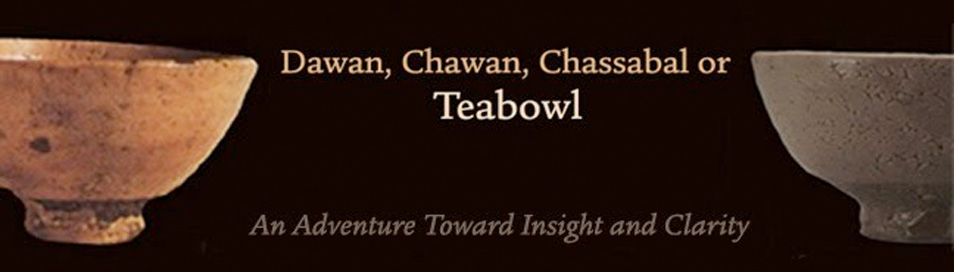
   Most of us first heard the term “chawan” related to Japanese Tea bowls, but the term really is Chinese and was used in both China and Korea before Japan. It may surprise you to learn that Korea held the first “tea ceremony” before either China or Japan.   Authentic documents suggest that the first 'tea' ceremony began in Korea in 661 CE.  The Silla King Munmu ordered tea to be used during ceremonial offerings. The term “dawan” or 'ceremonial bowl' is still used today for their ancestral rites ceremonies. Thus the first 'tea' ceremony gave birth to the first “dawan” (ceremonial bowl) for the drinking of tea. The term “wan” is Chinese for bowl. “Da” means ceremony and “cha” is tea. The ancient Korean "Cha-rye" tea rites ceremony for ancestors continues today. (see www.TeaTourKorea.com.  It also reviews Japanese Tea.)    China developed the first Tea ceremony, as we know it today, and the term “chawan”.   Like the word “cha” or tea, the word “wan” or bowl is Chinese.  Therefore the term chawan became the international term for Tea bowl – not just a Japanese Tea bowl.    Never the less, because the term chawan has become so associated with Japanese Tea, in recent years, Korea began using the term “chassabal”.  "Ssabal", also Anglicized “sabal”, means bowl in Korean or more specifically a bowl from which one eats - not a bowl from which one drinks.  In using the term “chassabal”, Korea is giving some nod to Japan who converted Korean ssabal - simple rice bowls - for use in their Japanese Tea ceremonies.
   It would be very easy to digress and follow the “Tea ceremony” path but our central topic is the Tea bowl, so I will leave most comments on the Tea ceremony to the many websites, YouTube postings, web sites and blogs that address that topic.  The links are my picks for today.  Please contact me with additional suggestions.  Also be aware that there are many types of Tea ceremonies including those for infused tea and powdered tea.  Each country's Tea aesthetic is very different and each "school" or even area within a country may have a series of different ceremonies.           Another purpose of this blog to to begin to shed more light on Korean Tea and Tea ware.  An author, who has studied both Japanese and Korean ceramics, recently told me that, "... removing all Korean influence from Japanese ceramics would be like removing all African Americans from the Jazz Hall of Fame".  When many in the West think "tea ceremony" or "tea bowl", they also think "Japanese".  I hope this blog will also serve to broaden our understanding.   From time to time I will invite others who have a particular expertise in tea ware or tea to post on this blog.  Your thoughts are welcome be you novice, artist or connoisseur.  Join us as we undertake the adventure that is "chawan".   Please submit your comments and suggestions in English. Your voice and insights are truly valued no matter what your level of experience. 
Click here to go to the next post.